This article from Popular Mechanics lists the top animal marathoners as the following, in order of marathon speed:
1. Ostrich
2. Pronghorn Antelope
3. Camel
4. Sled Dogs
5. Humans
6. Horses
Ostrich
.jpg/800px-Struthio_camelus_(Kunene).jpg)
"Struthio camelus (Kunene)" by Hans Hillewaert - Own work. Licensed under Creative Commons Attribution-Share Alike 3.0 via Wikimedia Commons - http://commons.wikimedia.org/wiki/File:Struthio_camelus_(Kunene).jpg#mediaviewer/File:Struthio_camelus_(Kunene).jpg

I, Tony Wills [CC-BY-SA-3.0 (http://creativecommons.org/licenses/by-sa/3.0)], via Wikimedia Commons
They have an incredibly large stride, covering from 9.8 to 16.4 ft with one step! Clocking in at a marathon pace of 30 mph, they could finish it in about 45 minutes.

I guess when you can't fly, you might as well run fast as hell!
Pronghorn Antelope
I'm sorry but I still can't muster up enough interest in these creatures. My eyes start glazing over when I start researching them. It makes no sense, given that they are both fast at sprinting and long distance running. Anyway, I will try to get in some facts out before I fall asleep.

Pronghorns have large windpipes, lungs and hearts compared to their body size, allowing them to take huge gulps of air while running. Their hooves are made up of two long, pointed toes that provide essential cushion to absorb the shock of running at high speeds. They are featherweights, with an incredibly light bone structure and hollow hair. Like ostriches, their marathon pace would be 30 mph. At least their marathon would only last 45 minutes. Hopefully we could all stay awake long enough to watch it.
.jpg/1024px-Antilocapra_americana_male_(Wyoming,_2012).jpg)
"Antilocapra americana male (Wyoming, 2012)" by Yathin S Krishnappa - Own work. Licensed under Creative Commons Attribution-Share Alike 3.0 via Wikimedia Commons - http://commons.wikimedia.org/wiki/File:Antilocapra_americana_male_(Wyoming,_2012).jpg#mediaviewer/File:Antilocapra_americana_male_(Wyoming,_2012).jpg
That was the most interesting picture I could find. Sorry. On to more interesting animals!
Most of the animals on the list live in warm temperatures. Thus, sled dogs are pretty impressive, given the fact that they can run through sub-zero temperatures and blizzard conditions. Sled dogs are thought to have evolved about 30,000 years ago, somewhere in Mongolia, and they started pulling sleds about 3,000 years ago. This Wikipedia page on sled dogs is worth a visit, but I will supply some of the nuggets I found. There are several breeds, but these three are the best, in my opinion.
Alaskan Malamute

"Alaskan Malamute" by SCMW - eigen werk / self-made. Licensed under Creative Commons Attribution 3.0 via Wikimedia Commons - http://commons.wikimedia.org/wiki/File:Alaskan_Malamute.jpg#mediaviewer/File:Alaskan_Malamute.jpg
Siberian Husky

"Siberian-husky" by Utopialand - self-made (http://www.utopialands.com). Licensed under Creative Commons Attribution-Share Alike 3.0-2.5-2.0-1.0 via Wikimedia Commons - http://commons.wikimedia.org/wiki/File:Siberian-husky.jpg#mediaviewer/File:Siberian-husky.jpg
Samoyed
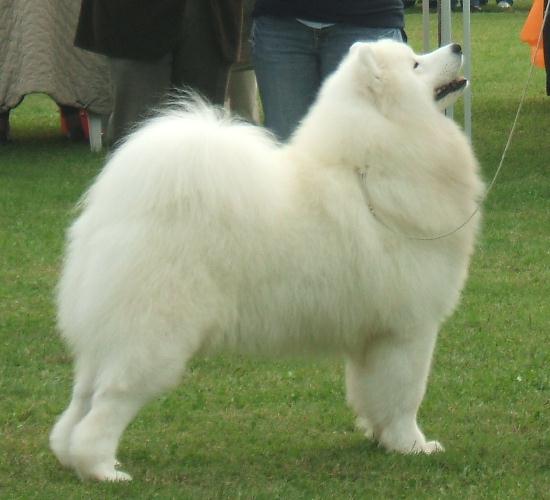
By Sweetjedysamoyeds.it (Own work) [GFDL (http://www.gnu.org/copyleft/fdl.html) or CC-BY-SA-3.0-2.5-2.0-1.0 (http://creativecommons.org/licenses/by-sa/3.0)], via Wikimedia Commons
Other than being some of the cutest dogs on the planet, their physical attributes basically make them snow machines. They have double coats, the outer coat for keeping snow away and the inner coat as waterproof insulation. Their webbed feet with closely spaced toes are incredibly tough, and basically serve as snow shoes. They use those bushy tails to keep their feet and noses warm while sleeping curled up. The blood vessels in their legs are uniquely arranged to protect against frost bite.
But, can these snow machines run? During the famous Iditarod race held every year in Alaska, teams of dogs run at about 15 mph for up to 6 hours at a time! That means they could run a marathon in about 1.5 hours. While that is impressive enough, the Iditarod is over 1,000 miles. Thus, they run at these speeds for about 15 days. The word Iditarod is an Athabaskan word, which I'm just going to go ahead and assume is the translation for Iron Dog.
On a side-note, all of that running requires the dogs to eat 10,000 calories a day.

"Excited malamute". Licensed under Creative Commons Attribution-Share Alike 3.0-2.5-2.0-1.0 via Wikimedia Commons - http://commons.wikimedia.org/wiki/File:Excited_malamute.JPG#mediaviewer/File:Excited_malamute.JPG
2,000 calories is the recommended daily calorie intake for humans, so that would be five days worth of food in one day. Sheesh.
So, sled dogs could kick our asses in the snow, but their extra fluffy coats would hinder them greatly in hot weather. Do any animals compete with us in hot weather?
Camel
Sled dogs seem like an obvious choice for a long distance runner, but camels really surprised me. I guess I always see them sort of ambling along. The desert doesn't seem like a place where you want to be using up a ton of energy with activities such as running.
Apparently, I am very much mistaken. As we all know, camels top the entire animal kingdom in terms of keeping cool and hydrated. They store fat in their humps, as opposed to having it evenly disbursed around the body. Since fat insulates heat, this helps them keep most of their body cool. Camels can withstand the largest range in body temperature change, from around 93 degrees Fahrenheit in the morning, up to 104 degrees Fahrenheit during the day. While most mammals can only withstand up to 12%-14% dehydration before suffering cardiac failure, camels can withstand up to 25%!
Camels have oval shaped, not circular, red blood cells which allow for better flow during dehydration. They also give camels the ability to drink 53 US gallons of water in one sitting.
Camel keg stands, anyone?
(Spree of college frat boys trying to illegally purchase camels starts now)
While I've always known camels have unique
characteristics to live in the desert, I really didn't know the specifics. A
science fiction writer couldn't have come up with a cooler alien. And, they can
run as fast as 40 mph.
Their marathon pace would be around 25 mph,
which means they could finish a marathon in about 1 hour and 2 minutes. Not
only is that fast, they could probably run a few marathons before needing a
water break!
Horse
Last, but certainly not least, is the horse. I was a bit surprised that they came in last on the list, after both humans and those crazy camels. Even more interesting is the fact that the horse is the only animal that humans have actually raced against. Yes, I'm serious. There is a man vs. horse race that is 22 miles in length, held every year in the small Welsh town of Llanwrtyd Wells. Doesn't Llanwrtyd sound like a perfect dragon name?

By (Jothelibrarian) (Own work) [GFDL (http://www.gnu.org/copyleft/fdl.html), CC-BY-SA-3.0 (http://creativecommons.org/licenses/by-sa/3.0/) or CC-BY-SA-2.5-2.0-1.0 (http://creativecommons.org/licenses/by-sa/2.5-2.0-1.0)], via Wikimedia Commons

Besides leaving their human competitors some major obstacles on the road, horses have better oxygen efficiency than humans. They have a biological mechanism that enables their spleen to immediately start producing red blood cells when they engage in exercise. Humans can only achieve this efficiency through doping. However, it seems that our ability to deal with heat surpasses the horse's blood efficiency. During the marathon, the horses always start out with about a 30 minute lead which, by the end of the race, gets cut to about 10 minutes.
We should be incredibly proud that we are included on the list of the top 6 animal endurance runners. While reading about all of these animals, I realized how much fear and self-preservation factors into the ability to run long distances. The top two animals have evolved the ability in order to keep away from predators. Dogs and horses have essentially been bred by humans for their ability. As we saw last month, we evolved the ability in order to persistence hunt. But, what about camels?

They just be crazy.

No comments:
Post a Comment